
Denys Berezhnyi
Information
About the Musician
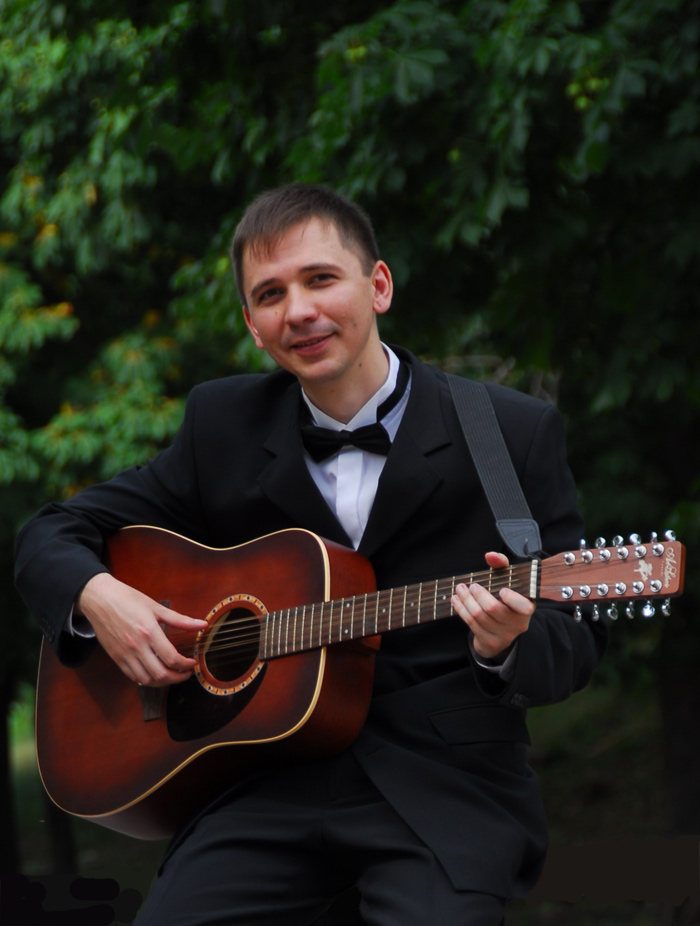 Denys Berezhnyi (b. 1974) is a Ukrainian singer, songwriter, voice & guitar educator. He graduated from the vocal department of the conservatory. His creative work is characterized by a combination of different genres and styles: his own art songs, settings of contemporary poetry, arias, romances, literary chanson, and international and ethnic music — all performed with his own guitar accompaniment. Simultaneous voice and guitar recording: no overdubbing or multitracking. Concerts are predominantly unamplified (no microphone).
From interviews:
“...No matter if an orchestra, an ensemble, or a rock band accompanies me, I always return to my own guitar accompaniment. The more serious and complex the piece is, the more thrilling it is to perform it honestly, professionally, and beautifully using minimal means: just voice and guitar”. (read more)
“...The idea of the kinship and unity between works of different vocal genres is important to me, as well as the possibility of combining them in this way, using the same instrumental means (voice and guitar)”.
Denys Berezhnyi worked his way from a street and restaurant musician to an opera and concert singer. He has been writing songs since 1988. In the early nineties he was a member of the rock bands Чорт на дзвіниці (Chort na Dzvinytsi) and Провокація (Provokatsia), a regular participant of Afghan telethons of repentance. Later, along with studying at the conservatory, he constantly performed concerts. He sang in many places — underground crossings, town squares, discothèques, clubs, restaurants, radio, television, music festivals, theaters, and concert halls. He formed his own audience during that time; he is working with these people now.
- Discography (details):
- Callsign “Donetsk”. Russo-Ukrainian War Song Cycle (13.03.2014–2026)
- Prewar (2013–2014)
- Ploughman’s Pathos (2012)
- Forward-backward (2012)
- Our Honour (2010–2011)
- Adamo in Russian (2010/2017, Joint album)
- Intellectual’s Comfort (2009)
- Gathering of Stones (2008)
- I am a sun-man and everyone wants to be warmed by my rays (2007, Studio “Laos”)
- A Book (2006, Studio DRSTRC)
- Shame (2005, Studio “Gorki 29”)
- Rebellion (2004, Studio “Gorki 29”)
- Belge (2003, Studio “FAT Records”)
- Plays at a fork in the road (1993)
- The Wind(1990)
- The Day (1989)
- Prewar (2013–2014)
Selected concert programs:
- 2012
- “Musical anthology of contemporary poetry”.
- “200-year Echo” Franco-Russian War of 1812 in romances of our contemporaries
(version: Allusions to the Franco-Russian War of 1812 in post-postmodern romances). - “200-year Echo” Franco-Russian War of 1812 in romances of our contemporaries
- 2011
- “Saint Petersburg romance of the 21st century” Romances and songs on poems by contemporary poets of St. Petersburg.
- “Moscow Still Alive” Songs on poems by contemporary poets of Moscow.
- “Listen to This Snow” A song cycle on poems by Natalya Malinina.
- “Moscow Still Alive” Songs on poems by contemporary poets of Moscow.
- 2008
- “Contemporary vocal music. Romances and songs on poems by the Internet age poets”.
- “Gubanov. Sosnora. Two northern birds” Romances and songs on poems by Leonid Gubanov and Viktor Sosnora.
- “Tick-Tock Citizen” A song cycle on poems by Konstantin Rupasov.
- “Gubanov. Sosnora. Two northern birds” Romances and songs on poems by Leonid Gubanov and Viktor Sosnora.
- 2001–2002
- Concert programs “Evolution of Romance” (Parts I and II) outlined changes to the genre from ancient times to the most recent trends. For the first time, romances from the operas of Donizetti, Wagner, Bizet, and others were performed with the singer's own guitar accompaniment, restoring the original chamber intimacy suggested by the opera librettos.
Also, Denys Berezhnyi has been teaching singing and accompanying on guitar individually since 1990, including remotely via webcam since 2011, and has taught hundreds of people around the world during this time. He has been a music producer and arranger for his students. Educational organizations and individual teachers widely use the practical methods of Denys Berezhnyi’s Guitar-plus-Vocal School in their work.
About the Music
 Denys Berezhnyi works with music of various genres, styles, and directions, consistently maintaining an individualistic approach to performance.
Repertoire and scope:
Opera, classical, and contemporary chamber and vocal music. One of his standout programs, “Evolution of Romance”, features operatic arias and romances performed with the artist’s own guitar accompaniment. In 2000, he introduced the musical term Progressive Romance to define a new direction in classical crossover. This style is characterized by the simultaneous mastery of voice and guitar, strictly eschewing any other accompaniment or multi-track layering.
French chanson. Performance in the original language and in translations.
Ethnic music. Romani folksongs (authentic and in translation), Ukrainian, Russian, Spanish, and Latin American (Peruvian and Bolivian) folk songs.
World popular and rock classics.
Wartime songs. Classics of the singer-songwriter genre, outlaw songs and other marginal music.
Concert programs with his own songs, which have represented contemporary serious music from the late 80s to the present day.
From an interview:
“Time is a very interesting topic for us. You should only approach rock music when you know every band in your city, or even in a huge country, by name, and can distinguish one style from another. When it was creatively unexplored, when it provoked the curiosity of the general public, I did it. But when the number of bands playing electric, synthetic music, and singers using weak, microphone-dependent voices, grew beyond measure — roughly starting from the early 90s — belonging to mainstream pop genres, both rock and pop music, became not only shameful but pointless. The same happened with some stagnant academic genres. A normal, true musician will always strive to do something personal and something new. Something that is rare, and something that does not yet exist. In my opinion, a singer should be a laboratory, not a museum. The best examples of contemporary poetry, composition based on melodism, and dignified live, acoustic performance — these are the three pillars of my work. Or, just to provoke the public: pathos, pathos, and more pathos. Noble music elevates noble poetry”.
© Denys Berezhnyi, denysberezhnyi.com.ua